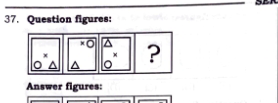
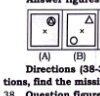
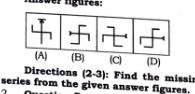
Directions (4-5): Complete the series of figures, by selecting correct answer figure from the given responses. 
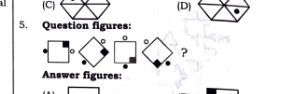
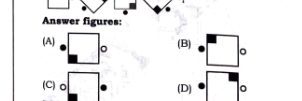
The symbols located at the corners of the square are rotating in a certain order. The correct answer is (C). 
एग्जाम गढ़
Fortifying your kingdom...
Your exams are loading with precision ⚔️
Directions (4-5): Complete the series of figures, by selecting correct answer figure from the given responses. 
The symbols located at the corners of the square are rotating in a certain order. The correct answer is (C). 
Arrange the following logical steps in the correct order to solve a pattern identification question:
Memorable Trivia: Always check the first-to-second transition and the second-to-third transition. If the rule is the same, you have successfully identified the sequence transformation.
Which statement correctly captures the logic of the 'Arrow and Shape Progression' pattern regarding the triangle shape?
| Shape Name | Number of Sides | Incremental Status |
|---|---|---|
| Triangle | 3 | Base |
| Square | 4 | Step 2 |
| Pentagon | 5 | Step 3 |
| Hexagon | 6 | Step 4 |
Exam Trap: 'Adding a side' effectively means increasing the polygon's complexity. Don't look for size changes if the rule specifically mentions side addition.
Match the following reasoning pattern types with their respective analytical definitions:
| Pattern Type | Analytical Definition |
|---|---|
| A. Element Mapping | 1. Main figure rotates 90° ACW while side figures rotate CW. |
| B. Rotational Shift | 2. Elements of figure 1 reappear in figure 3, and figure 2 elements in figure 4. |
| C. Structural Addition | 3. Symbols rotate and swap locations based on fixed points within a matrix. |
| D. Symbol Progression | 4. Adding small lines to the inner part by joining two adjacent lines. |
Select the correct matching code:
Which of the following scenarios best describes the 'Process of Deduction' in pattern sequence problems?
Sign up free to save progress
No credit card required
What distinguishes 'Structural Addition' from 'Increment of Elements' in logical figure series?
| Feature | Structural Addition | Increment of Elements |
|---|---|---|
| Core Component | Small lines | Dots (points) |
| Logic | Joining adjacent segments | Additive logic on central line |
| Outer Boundary | Often has moving arrow symbol | Remains static |
| Primary Visual Change | Connectivity within inner figure | Density of internal points |
The shape and orientation of the figures are evolving. Option (A) logically completes the series.
When analyzing a pattern sequence, if you observe the elements swapping top-to-bottom and left-to-right, what is this process called?
There is a change in the corners and curved edges of the shapes. Option (C) completes this pattern.
The positions of the 'X' and the circle inside the square are changing sequentially. Both are moving one corner at a time in a clockwise direction. Following this pattern, option (A) is the correct answer.
Test your complete preparation with timed mock tests. Get detailed analytics and compare scores with other aspirants.
In an 'Arrow and Shape Progression' pattern, if an arrow moves forward by one position, then two positions, what is the expected shift in the next step, and what is the status of the shape's color?
| Progression Type | Logic Example | Common Pattern |
|---|---|---|
| Linear Increase | +1, +2, +3... | Position Shift |
| Binary Alternation | B/W or W/B | Color Shift |
| Geometric/Rotation | 90°, 180°, 270° | Orientation |
Memorable Trivia: Series progression often combines spatial movement (jumps) with attribute oscillation (color). Solve one property at a time to narrow down the options.
In a grid progression, if an arrow points from the top-left cell to the bottom-middle cell, and the rule is a 'standard directional shift', how does the primary element move?
| Rule Type | Logic | Impact |
|---|---|---|
| Arrow Pathing | Vector-based | Defines destination grid-cell |
| Vertical Shift | Row-based | Updates grid rows |
| Rotation | Degree-based | Updates shape orientation |
Strategy: For any grid problem with arrows, mentally draw the paths first. If arrows are crossing, look for the 'intersection' rule (e.g., do they swap or stack?).
Assertion (A): In figure series, multiple shapes can follow different, independent movement laws simultaneously.
Reason (R): Analyzing a series involving a triangle moving diagonally and a circle moving anti-clockwise requires tracking their individual paths rather than a single common motion.
Select the correct answer code:
Consider the following statements regarding the behavior of figures in TCS symbol progression problems:
Which of the statements given above are correct?
Common Pitfall: If a pattern appears random, re-examine the cycle. Often the sequence resets or shifts rule every 3rd step, making it look 'independent' if you only look at steps 1 and 2.
Find the missing figure from the given responses. 
The pattern is based on rotation and the number of lines. The final figure (D) is the correct combination of the patterns. 
In a Sequential Matrix Shift, what happens to the elements as they complete one full cycle of the shift?
Concept Blueprint: Always identify the 'cycle length'. If the pattern repeats every 3 steps, the state at step 4 is identical to step 1. This is the fastest way to solve multiple-choice pattern questions.
Match the following figure series mechanics with their typical analytical focus:
| Mechanism | Analytical Focus |
|---|---|
| A. Rotation Logic | 1. Diagonal movement tracking |
| B. Multi-Shape Movement | 2. Relative degree change (e.g., 45°/90°) |
| C. Pin-like Shape | 3. Binary state oscillation (up/down) |
| D. Systematic Removal | 4. Alternating element deletion |
Select the correct code:
Match the following types of logical patterns with their primary structural characteristics:
| Pattern Type | Primary Characteristic |
|---|---|
| A. Element Mapping | 1. Addition of lines by joining adjacent segments |
| B. Structural Addition | 2. Rotation of all components together by 90° CW |
| C. Combined Rotation | 3. Analysis of relative shifts above/below each other |
| D. Sequence Analysis | 4. Specific rotations within a square boundary |
Select the correct code from the options below:
Question figures: 


Analyzing the pattern, the positions of the symbols (square, cross, triangle, circle) are changing at each step. They are rotating in a defined sequence. The correct answer is figure (C) which follows the logical sequence of the series.
Assertion (A): Identifying the static element is the most important step in simplifying a pattern series.
Reason (R): Once the static element is identified, it acts as a constant, allowing the examiner to disregard it while tracking the movement of other elements.
Select the correct code from the options below:
Sign up for free to save your progress, access unlimited questions, and get personalized recommendations.
Sign up free to unlock unlimited questions, save your progress, and access all Figure Series questions.
✨ Free forever • No credit card • 2 sec signup with Google
Reasoning